The Best Morning Workout Routine at Home (20 Minutes, No Equipment)
A complete 20-minute morning routine you can do beside your bed — mobility, strength, and a short cardio finisher to set up the rest of your day.


Morning workouts have a quiet superpower: they finish the hardest decision of your day before you check your phone. You don't need a gym, a coach, or even shoes. You need 20 minutes, a small patch of floor, and a routine that respects a body that just woke up.
Why Morning Workouts Work
Training in the morning raises your core body temperature, increases alertness through cortisol's natural rhythm, and improves blood sugar control for the rest of the day. A 2022 meta-analysis in the Journal of Physiology found morning exercise was as effective as evening sessions for fat loss when total volume matched.
The bigger win is psychological. A finished workout at 7am is a tiny declaration that today is yours.
The 20-Minute Routine
Do this circuit three rounds with one minute of rest between rounds.
Mobility Warm-up (3 minutes)
Cat-cow stretches × 10 World's greatest stretch × 4 per side Shoulder rolls × 10 each direction Standing side bends × 6 per side
Strength Circuit (12 minutes)
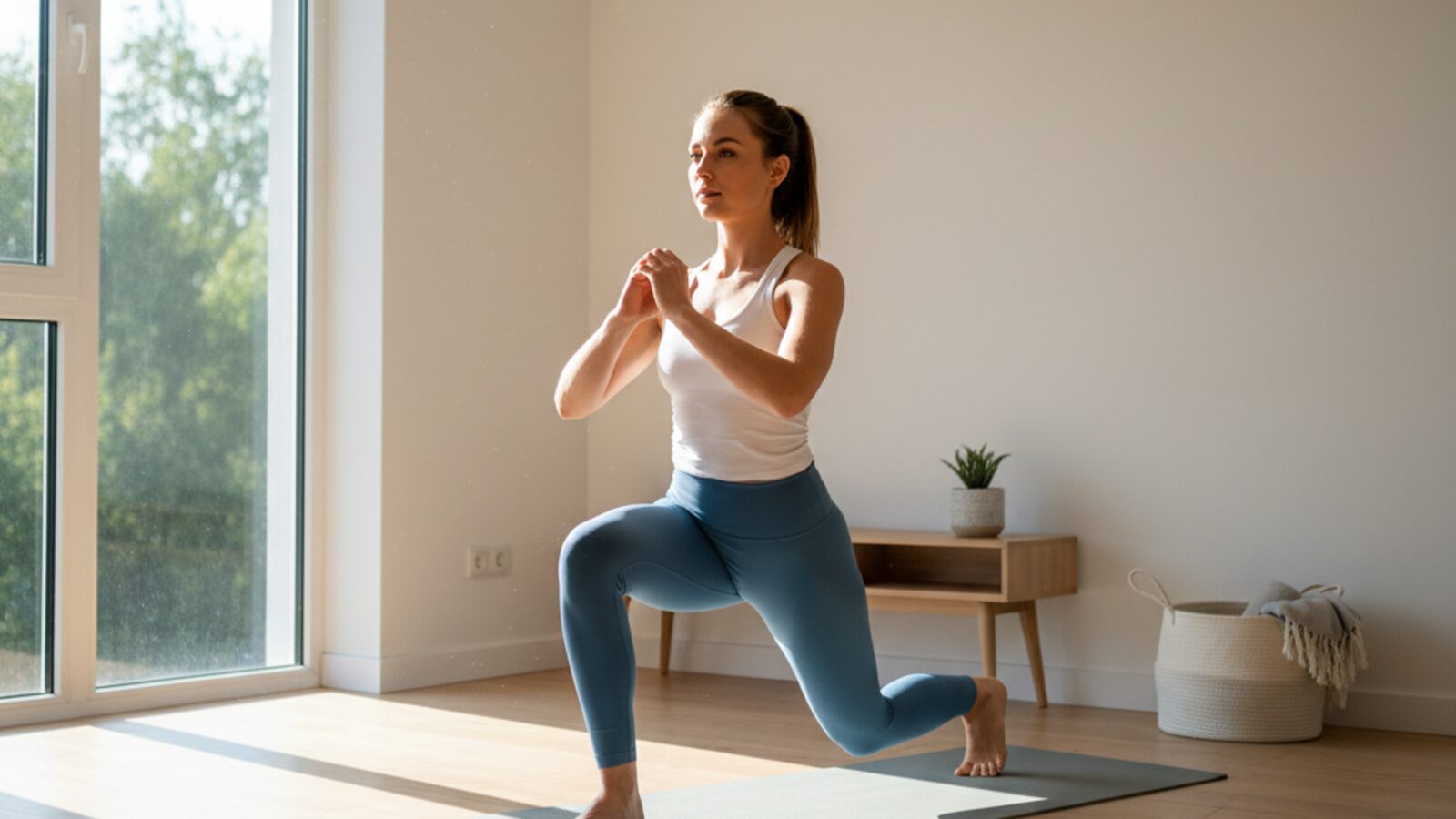
Bodyweight squats × 15 Push-ups (knees if needed) × 10 Reverse lunges × 8 per leg Glute bridges × 15 Forearm plank × 30 seconds
Cardio Finisher (3 minutes)
Jumping jacks × 30 seconds Mountain climbers × 30 seconds Rest 30 seconds, repeat once
Cooldown (2 minutes)
Forward fold × 30 seconds Child's pose × 30 seconds Three slow breaths through the nose, four counts in, six counts out
Form Cues That Save Your Joints
Squat: drive through your heels, keep your chest tall, and let your knees track over your toes — not collapsing inward.
Push-up: tighten your glutes, glance at the floor (not forward), and keep your elbows at a 45-degree angle from your ribs.
Plank: stack your shoulders over your elbows, squeeze your glutes, and resist the urge to let your hips sag.
How to Make It Stick
Lay out clothes the night before. Keep a glass of water on the nightstand. Pair the workout with something you already enjoy — a podcast, a playlist, the smell of fresh coffee waiting at the end.
Three sessions a week beats seven planned and zero done. Start with three, scale to four when it feels too easy.
The Deeper Science of Early Movement and Metabolism
The physiological transition from deep sleep to an active state is a delicate process governed by the circadian rhythm and the sudden surge of cortisol, often referred to as the 'cortisol awakening response.' When you begin a morning workout routine at home, you aren't just burning calories; you are signaling to your endocrine system that the day has begun. Research from the Mayo Clinic suggests that morning physical activity can improve sleep quality by helping to regulate the body’s internal clock. This early movement facilitates the flushing of metabolic waste products from the brain and tissues, providing a clearer mental state than caffeine alone can offer.
Furthermore, a 20-minute bodyweight routine initiates a process called non-exercise activity thermogenesis (NEAT) enhancement. By elevating your heart rate shortly after waking, you prime your metabolic furnace to burn energy more efficiently throughout the day. This isn't just about the 150–200 calories you might burn during the session; it’s about the 'afterburn effect' or excess post-exercise oxygen consumption (EPOC). While bodyweight exercises are less taxing than heavy lifting, the consistency of a morning routine ensures that the metabolic rate stays slightly elevated, preventing the sluggishness often associated with sedentary office work or long commutes.
Functional Strength Without the Heavy Lifting
While many believe that strenuous training is the only way to see results, the World Health Organization (WHO) emphasizes that regular, moderate-intensity movement is the cornerstone of long-term health. The brilliance of a no-equipment morning workout routine at home lies in its accessibility. When the barrier to entry is low—meaning you don't have to drive to a gym or find matching gear—consistency becomes exponentially easier to maintain. This psychological 'ease' reduces the friction that usually leads to burnout or skipped sessions. Over time, these 20-minute blocks accumulate into significant cardiovascular and musculoskeletal improvements.
From a structural standpoint, bodyweight exercises use the person's own mass to provide resistance against gravity. This type of closed-kinetic chain exercise is often safer for the joints than using machines, as it allows for a more natural range of motion. For beginners, this builds a foundation of functional strength—the kind of strength that helps you carry groceries, climb stairs, and maintain balance as you age. By focusing on multi-joint movements like squats, lunges, and planks in the morning, you are reinforcing the neural pathways responsible for coordination and stability.
Common Obstacles and Technical Mistakes to Avoid
One of the most frequent errors beginners make is jumping directly from the bed into high-intensity movements like burpees or sprints. When you first wake up, your spinal discs are slightly hydrated and expanded due to osmotic pressure during sleep, making them more sensitive to sudden loading or twisting. It is vital to spend the first 4-5 minutes of your 20-minute window on 'dynamic mobilization.' This involves slow, controlled movements that lubricate the joints with synovial fluid. Skipping this step increases the risk of lower back strains and tendonitis, particularly in the Achilles and patellar tendons.
Another common pitfall is the neglect of proper breathing techniques. Many people subconsciously hold their breath during challenging movements like planks or push-ups—a phenomenon known as the Valsalva maneuver. While useful in powerlifting, it can cause a sudden spike in blood pressure that is unnecessary and potentially uncomfortable first thing in the morning. Focus on exhaling during the exertion phase and inhaling during the return. Additionally, avoid 'grinding' through pain. There is a distinct difference between the 'burn' of muscle fatigue and the 'sharpness' of joint impingement. Learning to listen to these signals is crucial for a lifetime of fitness.
The 3-Minute Mobilization Protocol
1. Cat-Cow Stretch: Focus on mobilizing each vertebra individually. 2. Arm Circles and Leg Swings: These prepare the larger joints for a full range of motion. 3. Wrist Circles: Essential if you plan on doing planks or push-ups to prevent strain.
Red Flags in Your Form
1. Holding the breath (Valsalva maneuver). 2. Arching the lower back during core work. 3. Flaring elbows out too wide in push-ups. 4. Rounding the shoulders during squats.
Who Should Approach Morning Exercise with Caution?
A 20-minute morning workout routine at home is generally safe for the majority of the population, but certain groups should exercise caution. Individuals with pre-existing cardiovascular conditions, such as uncontrolled hypertension or heart disease, should consult a physician before starting any new exercise regimen. According to the American Heart Association, morning hours are when blood pressure tends to naturally rise, and sudden, intense exertion could pose a risk for those with underlying vascular issues. For these individuals, a slower, yoga-based or stretching-focused routine may be a safer starting point.
Pregnant women and those recovering from surgery should also seek professional guidance. In the case of pregnancy, hormonal changes like the release of relaxin can make joints more unstable, increasing the risk of sprains. Similarly, individuals with chronic inflammatory conditions like rheumatoid arthritis may find that their joints are particularly stiff in the morning. For this demographic, a 'warm-up for the warm-up'—such as a warm shower or five minutes of gentle marching in place—is necessary to ease the body into the routine without triggering a flare-up.
A Step-by-Step Template for Your Session
To ensure your 20-minute session is productive, follow this logical progression from low to high intensity. Start with two minutes of gentle movement (marching in place). Transition into three minutes of dynamic stretching, such as 'world's greatest stretch' or gentle torso twists. This prepares the nervous system for the work ahead and ensures that your muscles are sufficiently warm to stretch without tearing. Once the warm-up is complete, move into the 'power' phase of your routine, where you perform exercises that require the most energy, such as squats or lunges, while your focus is highest.
The middle 10 minutes should focus on a circuit of 4-5 exercises. For example: 45 seconds of air squats, 15 seconds of rest; 45 seconds of modified push-ups, 15 seconds of rest; 45 seconds of alternating lunges, 15 seconds of rest; and 45 seconds of a forearm plank. Repeat this circuit twice. This structure keeps the heart rate in a moderate zone—the 'fat-burning zone' according to many fitness experts—while building muscular endurance. Conclude the session with 2-3 minutes of static stretching, focusing on the hip flexors and chest, which are areas that tend to tighten during a day of sitting.
Sample No-Equipment Circuit
Circuit 1: Squats, Push-ups, Lunges, Plank. Circuit 2: Glute Bridges, Bird-Dogs, Mountain Climbers, Side Planks. High-repetition, low-impact movements are best for the morning.
Long-Term Sustainability and Progressive Overload
The secret to maintaining a morning workout routine at home for years, not just weeks, is the concept of 'progressive overload' and variety. The body is an incredibly adaptive machine; if you perform the exact same 20-minute routine every day, your progress will eventually plateau. To prevent this, you should look to increase the difficulty every few weeks. This doesn't require weights—you can increase the number of repetitions, decrease the rest periods, or move to a more challenging version of an exercise (e.g., moving from knee push-ups to full push-ups).
Beyond physical progression, mental sustainability is key. Harvard Health notes that 'habit stacking'—the process of pairing a new habit with an existing one—is a powerful tool. For instance, tell yourself you can only have your morning coffee after your 20 minutes of movement are complete. This creates a positive reinforcement loop. Additionally, allow yourself 'grace days.' If you are unwell or had a night of poor sleep, don't skip the routine entirely; instead, swap the high-intensity circuit for 20 minutes of restorative stretching. This maintains the habit of 'morning time for self' without overtaxing a compromised system.
When to Consult a Medical Professional
While most muscle soreness (DOMS - Delayed Onset Muscle Soreness) is a normal part of the adaptation process, there are specific signs that indicate you should pause your routine and consult a healthcare provider. If you experience chest pain, dizziness, or sudden shortness of breath during your 20-minute session, stop immediately. These can be symptoms of cardiovascular strain that require evaluation by a doctor. Similarly, if a joint becomes swollen or you experience 'night pain' that prevents sleep, you may have an overuse injury or a repetitive strain that needs professional diagnosis.
Physical therapists often recommend a 'test-retest' approach to morning stiffness. If your morning aches improve as you move, it is likely just standard morning stiffness. However, if the pain worsens as you progress through your squats or planks, it is a sign of inflammation or mechanical dysfunction. The NIH suggests that regular check-ups are important even for home-based exercisers to monitor blood pressure and joint health. A doctor or a licensed physical therapist can provide a personalized screening to ensure your home environment and exercise choices are aligned with your specific anatomy and health goals.
Symptoms to rarely Ignore
1. Sharp, stabbing pain in joints. 2. Numbness or tingling in the limbs. 3. Pain that does not resolve with rest. 4. Dizziness or fainting spells during exercise.
Final Thoughts on the Morning Transformation
As you integrate this 20-minute morning workout routine at home, consider the environment in which you exercise. Clear a dedicated space, keep your water bottle nearby, and perhaps open a window for fresh air. This sensory experience signals to your brain that this is 'work' time. Over the coming months, you will likely notice that your energy levels in the afternoon are more stable and your focus is sharper during work hours. The long-term benefits of this small daily investment are profound, impacting everything from metabolic health to cognitive longevity.
Ultimately, the best routine is the one that happens. You don't need to be an elite athlete to reap the rewards of morning movement. By respecting your body’s morning physiology, avoiding common technical errors, and slowly increasing the challenge, you are building a fortress of health that will serve you for decades. Start tomorrow—not with a grand transformation, but with 20 minutes of intentional movement on the floor of your living room. Your future self will thank you for the consistency you chose today.
Key Takeaways
- 20 minutes, three rounds, no equipment — done before breakfast.
- Morning workouts improve mood, focus, and blood sugar control all day.
- Form beats intensity; protect your joints for the next decade of training.
- Three sessions a week is the sweet spot for beginners.
Frequently Asked Questions
Should I eat before a morning workout?
For 20 minutes of bodyweight work, fasted is fine for most people. If you feel lightheaded, a banana or a small glass of milk twenty minutes before is enough.
How soon will I see results?
Energy and mood improve within a week. Visible strength changes take 4–6 weeks of consistent training plus enough protein (around 1.6g per kg of bodyweight).
Can I do this routine every day?
Yes for the mobility section. Take at least one rest day per week from the strength portion to let muscle tissue recover.
Conclusion
A short morning workout is not about getting ripped before breakfast — it is about owning the first hour of your day. Try the routine for two weeks and notice what changes. The body adapts faster than you think.
Sources & Further Reading
More on Fitness & Workouts
- → Building Functional Strength: Why Compound Movements Matter
- → HIIT vs Steady-State Cardio: Which One Works Best for Endurance?
- → Home Workout Without Equipment: A 30-Minute Full-Body Plan
You may also like
Home Workout Without Equipment: A 30-Minute Full-Body Plan
A balanced 30-minute home workout using nothing but your bodyweight, your breath, and the floor under your feet.

The 8 Best Exercises for Belly Fat (And the Truth About Spot Reduction)
The eight movements that build a strong core and burn calories — plus the honest truth about whether you can target belly fat.

10 Yoga Benefits for Beginners (Backed by Science)
Ten research-backed benefits of starting a beginner yoga practice — many show up within the first month.